How Long Will a Solar Generator Last During a UK Power Cut?
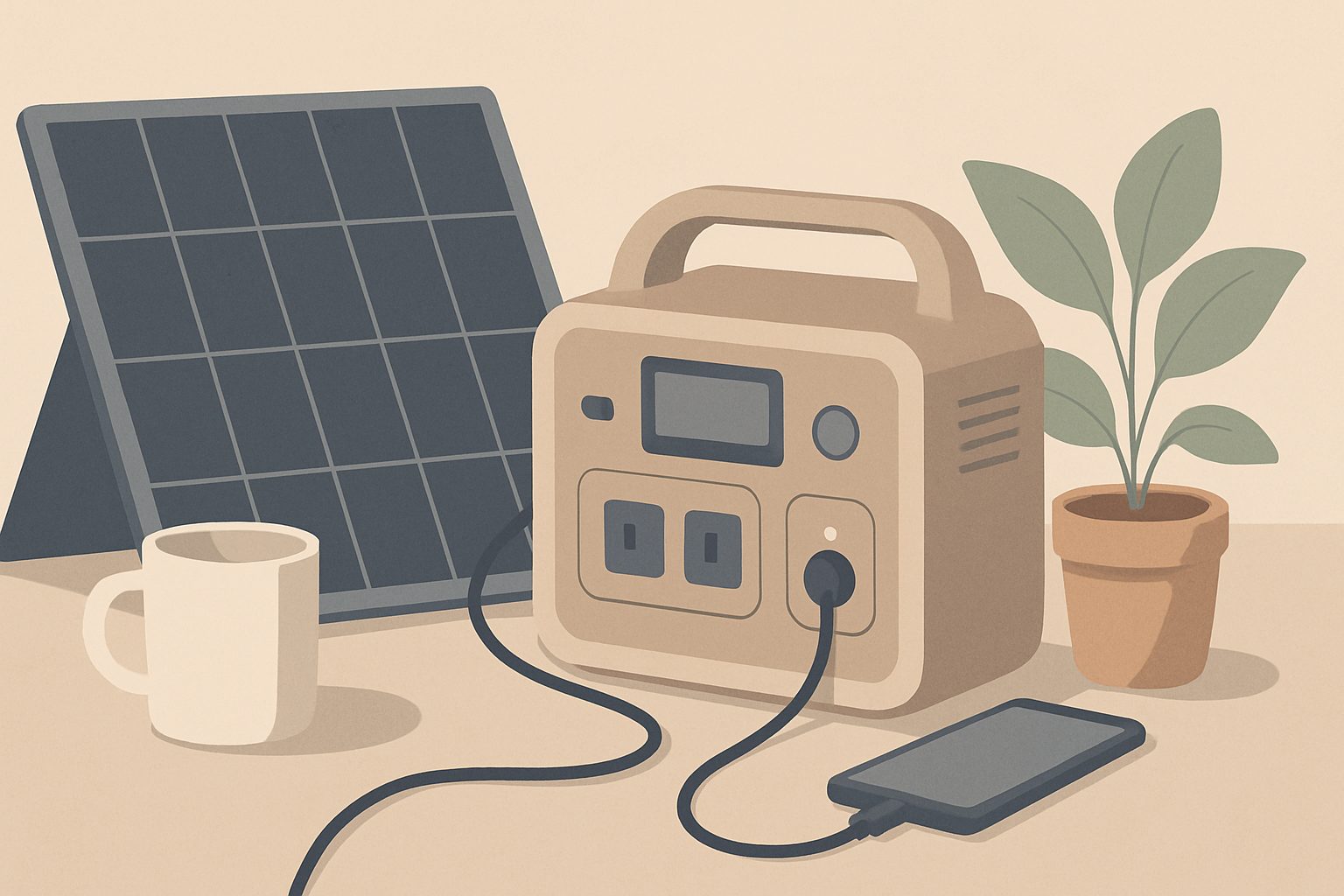
A summer power cut and a winter one tell very different stories with a solar generator. The headline answer: a 1kWh unit running essential kit (fridge, router, lighting) will stretch 12–24 hours, but recharge to full on a sunny summer day takes 8–12 hours. Winter? Add another week to recovery time, which is why capacity and what you actually run matter far more than the generator's headline specs.
Runtime: What Actually Drains the Battery
Solar generators have two separate limits: the energy stored (measured in watt-hours) and the power they can deliver at once. A 500Wh unit won't run a 2kW kettle, full stop. But within those constraints, runtime is straightforward maths.
If your generator holds 1000Wh (1kWh) and you draw 100W continuously, that's theoretically 10 hours before the battery is flat. In practice, you'll get 85–95% of that, depending on efficiency losses and the battery's real capacity at point of discharge.
Here's what common UK appliances actually pull:
| Appliance | Average Draw | |-----------|-------------| | Fridge | 150–250W (peaks higher, runs intermittently) | | WiFi router | 10–15W | | LED ceiling lights (1–2) | 20–40W | | Television | 50–150W | | CPAP machine | 60–90W | | Laptop charging | 40–80W | | Mobile charging | 10–20W |
Note: fridges and freezers cycle on/off; that 150–250W is the running figure, not continuous. They'll run much longer than the maths suggests at first glance.
Runtime Tables: Four Generator Sizes
Assuming average real-world conditions (not peak discharge, accounting for inverter efficiency losses of ~10%):
500Wh Generator
| Load Profile | Runtime | |-------------|---------| | Fridge + router + lights (200W avg) | 2–2.5 hours | | Router + 2 lights only (30W) | 14–16 hours | | CPAP + lights (100W) | 4–5 hours |
Verdict: 500Wh is a portable power bank, not an outage solution. Fine for device charging and running one small appliance, not for household backup.
1kWh Generator
| Load Profile | Runtime | |-------------|---------| | Fridge + router + lights (250W avg) | 3.5–4 hours | | Router + 3 lights + TV (100W avg) | 8–10 hours | | Fridge only (intermittent, 150W avg) | 6–8 hours | | Router + lights only (30W) | 28–32 hours |
Verdict: Covers 1–2 days of essential-only backup. A working fridge, comms, and lighting—but not much else running simultaneously.
2kWh Generator
| Load Profile | Runtime | |-------------|---------| | Fridge + router + lights + TV (300W avg) | 6–7 hours | | Fridge + router + lights (200W avg) | 9–11 hours | | Router + lights only (30W) | 60+ hours |
Verdict: Genuine 24–36 hour backup for a small household on essentials. Add a second day of solar input and you're weathering most outages without stress.
3.6kWh Generator
| Load Profile | Runtime | |-------------|---------| | Fridge + router + lights + TV + microwave (600W avg usage) | 5–6 hours | | Fridge + router + lights + laptop charging (250W avg) | 12–15 hours | | Essentials only (150W avg) | 24+ hours |
Verdict: Three days of realistic household backup without rationing. Close to what a mains battery system offers, at a fraction of the cost, if solar tops it up daily.
Recharge Times Under UK Sun
This is where UK geography bites. Summer and winter solar input differ dramatically.
Summer (June–August): A 1kWh generator depletes at midday will hit 80% charge by 6–7pm on a clear day, assuming 400W average panel power. That's realistic with a quality 200–400W panel. Full recharge: 8–12 hours' usable daylight.
Winter (December–February): The same generator, fully depleted, needs 4–5 full sunny days to recover. Winter noon sun is weak—UK latitudes see panels averaging 50–150W even in clear conditions. Overcast December? Three weeks isn't impossible. Cloudy stretches genuinely do happen, and a 500Wh shortfall over a sustained outage compounds fast.
Shoulder seasons (autumn/spring): Expect 18–30 hours for a full recharge cycle, depending on cloud cover.
The takeaway: winter backup relies less on solar recharge and more on having enough stored capacity before the outage hits.
What Kills Runtime in Real Life
Temperature: Cold halves battery capacity. A generator showing 2kWh at 20°C might deliver only 1kWh at 0°C. Winter outages are worst-case scenarios.
Age: After 300–500 charge cycles (2–4 years of daily use), capacity drops 10–20%. After five years, expect 30% loss. Solar generators aren't designed for daily cycling like smartphones; they degrade noticeably.
Phantom draw: Even on standby, modern UPS-style units bleed 20–50W through the inverter's always-on circuits. Irrelevant over hours, significant over weeks.
Cable and inverter losses: Cheap extensions or old wiring eat 5–15% before current reaches your appliances.
A Realistic Scenario
Your 2kWh generator is fully charged Wednesday evening. Thursday morning the grid goes down. You run the fridge, router, and a few lights—about 200W average. You get roughly 9 hours of continuous discharge.
Thursday afternoon, the sun's still weak (it's March). Two 400W panels bring in maybe 800W on an overcast day, but only 4 hours of useful charging before dusk. Net result: you've recharged about 30% of what you discharged. Friday, you're down to 1.5kWh. By Saturday, essentials only. By Sunday, you're rationing heavily unless the sun improves or the grid comes back.
That's not a failure—it's real-world. But it shows why people say "solar generators last 1–3 days," not weeks, without grid restoration.
Lifespan and Durability
Most quality units (LiFePO₄-based) will work for 10+ years, though battery capacity drops steadily. The real wear comes from regular deep-discharge cycles. Kept topped up and used only for outages, a solar generator lasts 15+ years easily. Used daily as a battery backup, expect 5–8 years at usable capacity.
Bottom line: A 1–2kWh solar generator is your practical household safety net for UK power cuts—not an indefinite power source. Realistic duration is 12–36 hours depending on what you run. Winter recharge is slow. But matched with even basic solar panels and clear expectations, it handles the outages that actually happen.
More options
- EcoFlow DELTA Pro Portable Power Station (Amazon UK)
- Jackery Explorer 2000 Plus Solar Generator (Amazon UK)
- Bluetti AC200P Portable Power Station (Amazon UK)
- EcoFlow 220W Bifacial Solar Panel (Amazon UK)
- Jackery SolarSaga 200W Solar Panel (Amazon UK)