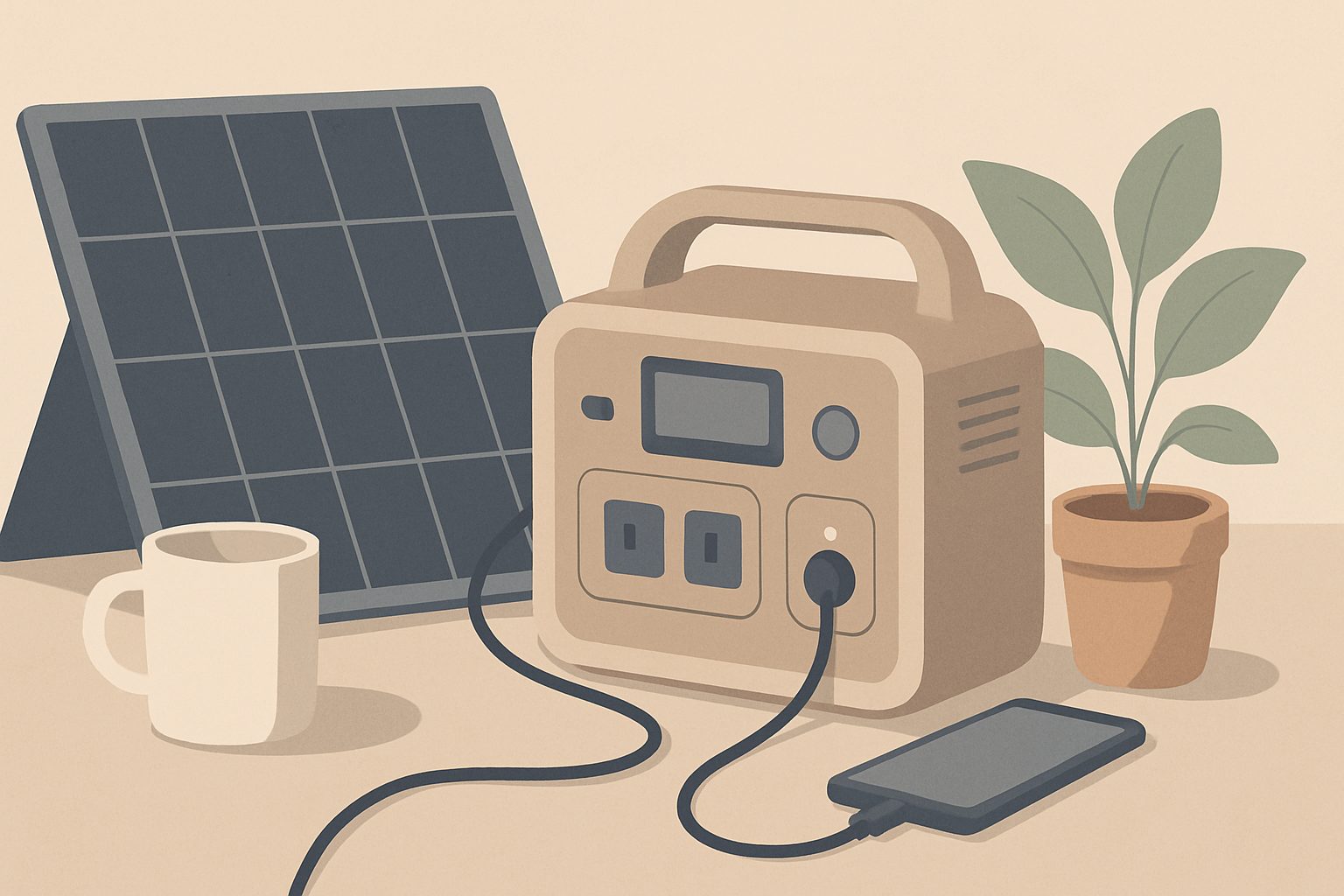
How to Charge a Solar Generator in UK Weather – Maximise Output Year-Round
Charging a solar generator in the UK isn't the same as deploying panels in sunnier climates. Our maritime weather, variable cloud cover, and lower solar irradiance mean that generic advice from US-centric guides often falls short. But the UK's diffuse light conditions—where clouds scatter rather than block radiation—create opportunities that most people overlook. With the right approach, you can reliably charge your solar generator even on overcast days, and maximise output across seasons.
Understanding UK Solar Irradiance and Seasonal Patterns
The UK receives an average of 1,000–1,100 kWh/m² of solar energy per year, depending on location. This is genuinely lower than southern Europe or the US, but it's more than sufficient for practical solar generator use if you optimise for the conditions you actually get.
Regional variation matters. South England and South Wales receive roughly 1,050–1,100 kWh/m² annually. The Midlands and South Scotland sit around 950–1,000 kWh/m². Northern Scotland receives closer to 850–900 kWh/m². Monthly irradiance peaks in June (around 160–180 kWh/m² in the south, 130–150 kWh/m² in the north) and bottoms out in December (20–30 kWh/m² across all regions).
Crucially, UK cloud cover generates diffuse radiation—indirect sunlight scattered through the atmosphere. Even on heavily overcast days, your panels receive 20–40% of clear-sky irradiance. This means dead-flat days are rare; grey days still produce usable charge.
Choosing Panel Type: Monocrystalline vs Polycrystalline
In direct sunlight, monocrystalline panels are 2–3% more efficient than polycrystalline equivalents. In diffuse light—which dominates the UK—this gap shrinks to 0.5–1%. If you're buying solar generator panels, monocrystalline makes sense for portability (higher output per kilogram), not because polycrystalline is useless here.
Budget polycrystalline panels under 200W aren't worth the space penalty. But if you're comparing a 100W monocrystalline portable panel to a 100W polycrystalline fixed installation, efficiency differences are negligible. Monocrystalline panels also tolerate temperature better—UK winters are cool, and panel efficiency actually improves as temperature drops—so the advantage compounds slightly in winter.
Optimal Panel Tilt and Orientation by Region
Fixed panel angle matters more than most people realise. The optimal year-round tilt angle roughly equals your latitude minus 2–4 degrees. For practical purposes:
- South England and South Wales: tilt 48–50°
- Midlands and Central Scotland: tilt 52–54°
- Northern Scotland: tilt 56–58°
South-facing orientation is non-negotiable: east or west-facing cuts output by 15–20% even in good light, and more on cloudy days where diffuse radiation arrives from a narrower sky patch.
If your generator uses a portable panel with built-in stand, experiment with angle through a single week—start at your latitude minus 3° and adjust by 5° increments, logging output each day. The variation often surprises people. In summer, a shallower angle (30–35°) beats theoretical optimum because the sun climbs high; in winter, steeper angles (55–60°) compensate for the lower arc.
MPPT vs PWM Controllers: Which Matters for the UK
Both solar generator batteries use one of two charge controller types: MPPT (maximum power point tracking) or PWM (pulse-width modulation).
PWM controllers are cheaper and simpler. They work fine for small portable generators (under 400W panel capacity) and situations where panel voltage closely matches battery voltage. In UK cloudy conditions, where irradiance is variable and diffuse, PWM loses 10–15% of available energy to inefficiency.
MPPT controllers cost 30–50% more but recover 15–25% additional energy in low-light conditions by continuously adjusting the voltage the panel "sees." For generators larger than 400W panel capacity or year-round stationary use, MPPT pays for itself within 2–3 years through recovered charge. For a portable 200W unit used occasionally, PWM suffices.
Real-world test: identical panels under winter UK skies generate roughly 17–20% more charge through an MPPT controller than PWM. That gap widens on genuinely cloudy days and shrinks on clear winter mornings.
Backup Charging: AC Mains and Car Charging
No solar generator charges adequately from panels alone during December–February in the UK. Most users underestimate winter demand. The solution isn't larger panels (diminishing returns); it's backup charging.
AC mains backup is straightforward: plug the generator into a standard household outlet using the built-in charger. A 2–3 kW generator typically charges at 500–750W, refilling from empty in 8–12 hours. This is your reliable winter strategy.
Car charging via 12V DC or USB-C is slower but useful when you're away from mains power. Many modern generators accept car-charging inputs (check your model). Expect 100–200W input from a car outlet—useful for maintenance charging or topping-up during the day if you're on site.
Seasonal Charging Strategy
May–September: Panels handle most load. Run AC mains charging only 1–2 times per month.
March–April, October–November: Hybrid approach. Use solar for 40–50% of your charge, supplement with 1–2 mains charges weekly.
December–February: Rely primarily on AC mains (2–3 times weekly), treat solar as bonus. Even a single clear winter's day can add 5–10% to your battery.
Realistic Expectations in UK Weather
A well-positioned 400W panel array in an unshaded location will deliver roughly 150–180 kWh per year to your battery in southern England, accounting for losses. That's enough to maintain a 5 kWh generator on solar alone during summer and shoulder seasons, supplemented by mains in winter. Don't expect your portable 200W panel to independently power a 10 kWh generator year-round; solar is your summer tool and winter insurance policy.
Accept that UK solar works best as a system: panels for fair-to-good weather, mains for winter, cloud days as bonus harvest windows rather than expectations.
More options
- EcoFlow DELTA Pro Portable Power Station (Amazon UK)
- Jackery Explorer 2000 Plus Solar Generator (Amazon UK)
- Bluetti AC200P Portable Power Station (Amazon UK)
- EcoFlow 220W Bifacial Solar Panel (Amazon UK)
- Jackery SolarSaga 200W Solar Panel (Amazon UK)