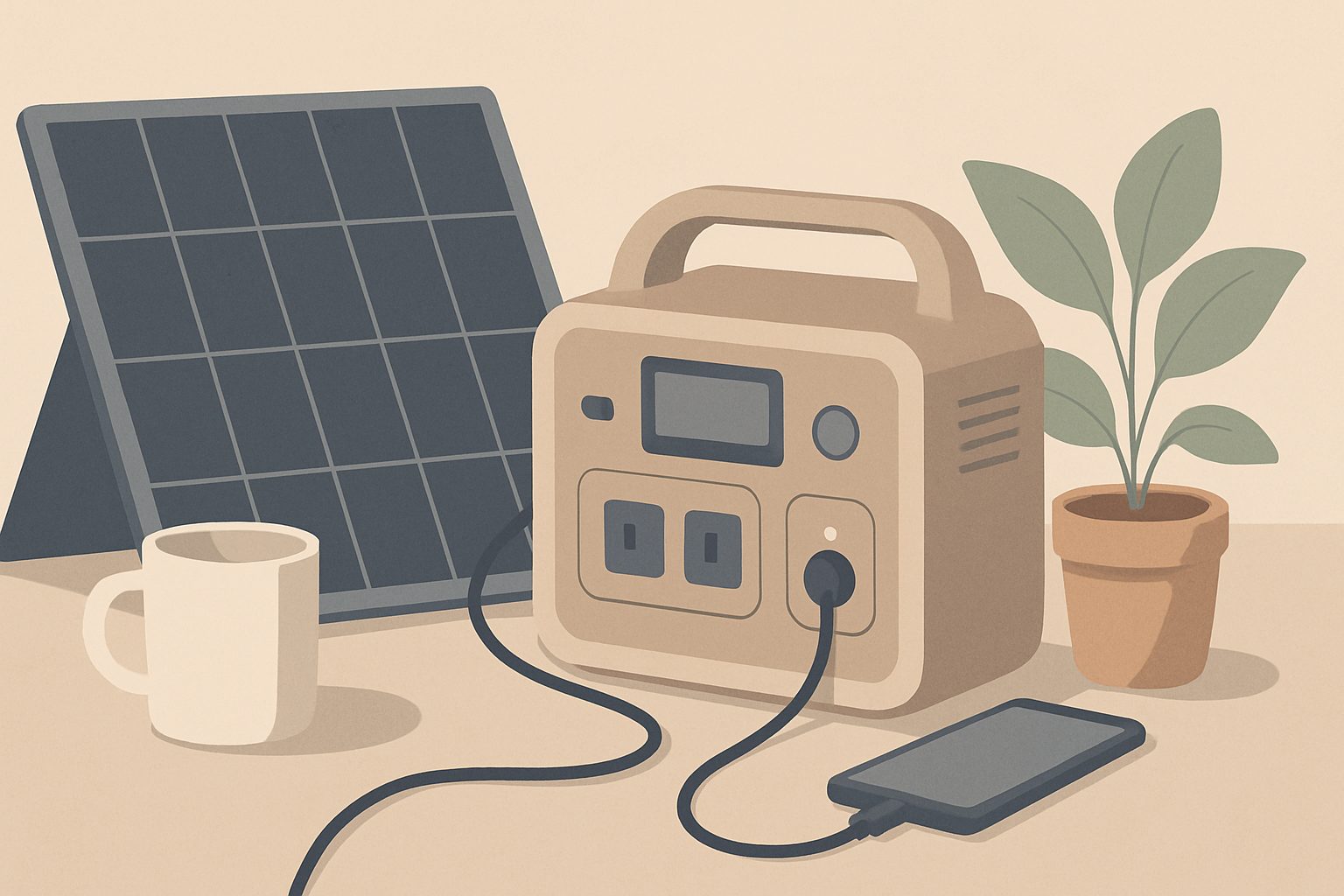
How to Size a Solar Generator for Your Home UK – Step-by-Step
Choosing a solar generator that actually meets your needs—not undersized and useless, not oversized and wasteful—comes down to honest maths. The UK receives less peak sunlight than sunnier climates, which changes the equation significantly. This guide walks you through calculating your real household energy demand, then matching it to a generator and solar array that will work in British conditions.
Step 1: Calculate Your Daily Energy Needs
Start by measuring what you actually use. The easiest way is to check your electricity bill for monthly kWh consumption, then divide by 30 to get average daily usage. For example, an average UK household uses around 8–12 kWh per day.
However, solar generators are usually sized for off-grid periods or backup power, not full household consumption. So you need to decide: are you backing up your entire home, or just essential circuits (lighting, fridge, heating pump, phones)?
For essentials only: List the appliances you'd use during an outage:
- Fridge/freezer: typically 150–300W continuous
- Boiler pump: 50–100W when running
- LED lighting (5–8 rooms): 50–100W total
- Phone chargers, router: 30–50W
- One water heater or kettle (occasional): 2000–3000W peak
For partial home backup: Include some creature comforts like a TV (100–200W), washing machine (2000W peak), or electric oven (3000W+). The more you add, the larger your generator needs to be.
Add up the continuous wattage (steady-state power) for all these, then multiply by your expected hours of use per day. If you're running essentials for 8 hours, and your essentials draw an average of 300W, that's 2.4 kWh per day.
Step 2: Account for Peak Loads and Surge Power
Solar generators must handle two power ratings:
- Continuous output: steady power the unit can deliver indefinitely
- Peak/surge output: brief bursts when appliances start up
A fridge compressor startup might spike to 5× its running wattage. An electric kettle or microwave pulls 3000W instantly. If your generator's peak rating is below your largest single appliance, it won't run that appliance at all.
Choose a generator with peak output at least 1.5× the highest single appliance you plan to use. If your kettle is 3000W, you need 4500W peak minimum. For "essentials only," often 3000–5000W peak is enough. For partial home use, 6000–8000W is safer.
Step 3: Map Battery Capacity to Your Needs
Solar generator battery capacity is measured in watt-hours (Wh) or kilowatt-hours (kWh).
Using your daily watt-hour calculation: If you need 2.4 kWh per day, and you want 2 days of autonomy (power in bad weather), you need at least 4.8 kWh of usable battery. Most manufacturers rate usable capacity lower than total—often 80–90%—so add a buffer. A 6 kWh battery with 85% usable capacity gives you roughly 5.1 kWh of real storage.
For partial loads over shorter periods: If you're backing up just essentials for 8 hours at 300W average, that's 2.4 kWh. A 3–4 kWh generator covers this with margin.
A rough sizing table for UK households:
| Use Case | Typical Daily kWh | Recommended Battery Size | Examples | |---|---|---|---| | Lights, fridge, router, heating pump only | 1–2 | 2–3 kWh | Short outage, shed/garage backup | | Above + occasional water heating/microwave | 2–4 | 4–6 kWh | 24-hour backup for essentials | | Above + some appliance use (washing, TV) | 4–8 | 8–12 kWh | Multi-day resilience, hybrid homes |
Step 4: Size Solar Panels for UK Peak Sun Hours
The UK averages 3–4 peak sun hours per day depending on location and season. Southern England gets closer to 4 hours; Scotland closer to 3. Winter is far lower—sometimes 1–2 hours—so if you're planning for year-round independence, size for winter or accept seasonal limitations.
Formula: (Battery capacity in Wh ÷ Peak sun hours) × 1.25 buffer = Solar wattage needed
Example: A 5 kWh battery, assuming 3.5 peak sun hours per day, with a 25% buffer for dirt and efficiency losses:
- (5000 Wh ÷ 3.5 hours) × 1.25 = 1785W of solar panels
In practice, you'd buy 2000W (a 2 kW array). This recharges your battery fully on a good sunny day. If you're in a cloudier region or want faster recharge, add 30–40% more wattage.
For winter backup: If you need the battery charged by mid-winter (1.5–2 peak sun hours), the solar requirement doubles. Most UK homes planning winter independence use a hybrid approach: mains electricity backup, or accept lower daily usage in winter.
Practical Example: A Three-Bed Semi-Detached Home
Let's say your essentials are:
- Boiler pump (75W, 4 hours daily): 300 Wh
- Fridge (250W continuous): 6000 Wh
- Lighting and router (100W, 6 hours): 600 Wh
- Total: ~6.9 kWh per day
Your largest appliance is the fridge at 250W, so you need at least 375W peak (though a 3000–5000W generator gives headroom for occasional kettle use).
For 2 days autonomy: aim for 8–10 kWh battery. A 10 kWh unit is realistic.
For solar: (10,000 Wh ÷ 3.5) × 1.25 = 3570W. Buy a 3.5–4 kW array (typically 8–10 panels at 400W each).
Cost comparison: a 10 kWh battery is roughly £8000–12,000. A 3.5 kW array adds £4000–6000. Running costs are zero—just maintenance and eventual battery replacement (10–15 years).
Common Sizing Mistakes
- Only looking at kWh, ignoring peak wattage. A 5 kWh generator with 3000W peak cannot run a 2 kW microwave, no matter how big the battery.
- Underestimating real usage. Most homes find they need 20–30% more capacity than their "essentials only" estimate once they account for seasonal variation and comfort items.
- Sizing solar for summer only. UK winter charging is drastically slower. Either plan for hybrid power or accept reduced capacity November–February.
- Ignoring depth-of-discharge (DoD). Lithium batteries last longest if you don't fully drain them daily. A 10 kWh battery used only 80% daily (8 kWh usable) lasts longer than one hammered to 100% discharge.
Next Steps
Once you've calculated your needs, compare specific models by their continuous power rating (not just peak), usable battery percentage, and expandability (can you add more panels or battery modules later?). Look at warranty length—quality UK retailers increasingly offer 10-year battery warranties. Check whether the unit is compatible with your existing solar setup, if any.
Sizing correctly upfront saves money and frustration down the line.
More options
- EcoFlow DELTA Pro Portable Power Station (Amazon UK)
- Jackery Explorer 2000 Plus Solar Generator (Amazon UK)
- Bluetti AC200P Portable Power Station (Amazon UK)
- EcoFlow 220W Bifacial Solar Panel (Amazon UK)
- Jackery SolarSaga 200W Solar Panel (Amazon UK)